
Discover our expertise in bridge construction, modular construction, civil utility construction and the solutions we offer for your projects with sustainable and efficient construction methods.

Discover our expertise in bridge construction, modular construction, civil utility construction and the solutions we offer for your projects with sustainable and efficient construction methods.
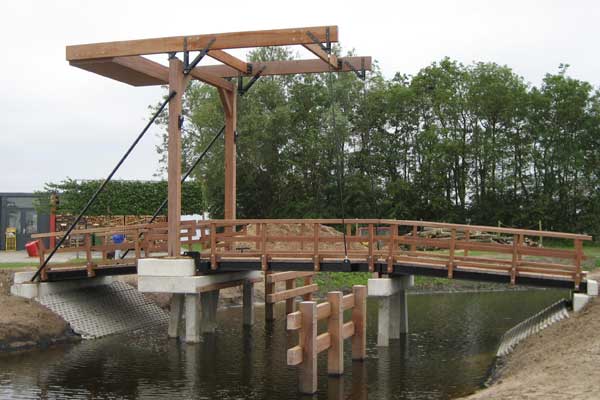
Drawbridges are among the most ingenious and characteristic road and hydraulic engineering structures in the world. An optimally constructed drawbridge not only seamlessly matches the intended use, but certainly also the environment.
Groot Lemmer specializes in drawbridges and is therefore an expert in the field of design, engineering, placement, assembly and maintenance of drawbridges. Everything is possible. From mechanical to automatic operation and from wood and steel to plastic and concrete.




Discover our innovative and environmentally friendly construction solutions and request a no-obligation quote that perfectly matches your project objectives.
There are various possibilities for bridges when it comes to types of deck and designs of railings. View the various possibilities here.
The bridge can be provided with a deck made of wood, plastic or steel.
Wood
Wooden decks can be supplied with or without grooves. With both options, it is recommended to include GLstrip in the wooden deck. For this purpose, dovetail grooves (preferably 2 in a plank width of 19 cm.) are made in the deck section, filled with epoxy and sprinkled with sand. The deck is thus rough in practically all weather conditions. It is better to use GLstrip than a wear layer over the entire deck. When using GLstrip, the wood is not sealed off and has a longer lifespan. If you want a covering wear layer over the entire deck, it is better to use a synthetic material. (see below)
Bamboo
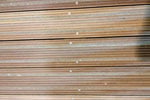
Bamboo is used as a composite material as deck and railing wood. The bamboo stem is peeled, cut into strips, dried and then pressed into a plank with glue in a mold. The result is a dimensionally stable plank. Bamboo can of course be supplied FSC-certified. The bamboo deck can also be provided with GLstrip.
Plastic
Plastic deck is made of glass fibre reinforced plastic (GRP). These are panels of 50 cm wide which fit together with a hollow/double connection. Plastic has a longer lifespan than wood and is extremely suitable for applying a wear layer. The wear layer has good adhesion to this surface. In order not to be dependent on the weather, the wear layer is applied in our factory. Standard colours are anthracite and red. GRP deck is also suitable if a service vehicle has to cross it. It is not suitable as a deck for bridges where horses walk over.

Steel
Steel is used for heavy loads or special requirements such as a watertight surface. This application is the most expensive of the decks mentioned here. Steel must be precisely cut to size in advance so that no adjustments have to be made during construction. This is at the expense of corrosion protection. A steel deck does have a long lifespan.

Railings come in many shapes and sizes. Below are a number of possibilities. For special designs, you can always contact us. Railings can be made of wood, steel, plastic or a combination of different materials.
| Type of railing | Description | Image |
|---|---|---|
| Rule-breaking | Consists of 1, 2 or more horizontal battens mounted against the uprights, with or without a top batten. | 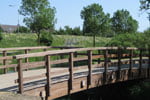 |
| Bar railing | Consists of vertical bars between the structural uprights. |  |
| Style railing | Railing consists solely of structural posts. | 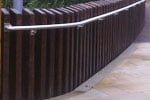 |
| Cross railing | Filling between the posts in the shape of a cross. | 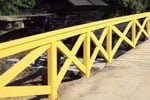 |
| Specials | Made to your specifications, you provide a sketch, we make the railing. |  |
You can view and download our certificates at certificates page.
Traditionally, much of the construction is done in wood. Wood is the only building material that renews itself.
The most recent study into the impact of various materials in the report “Comparative study LCA bridges, determining the sustainability score of bridges made of steel, concrete, composite and wood, published September 2013” shows that wood is the most environmentally friendly building material.

You can download the complete report download here.
Advantages of wood:
Steel is suitable for making large spans with a relatively low construction height. With good conservation (this guide can help you download here) a long lifespan can be achieved. However, when working with steel, the dimensions must be very accurate because it is not wise to perform any further processing on the steel during construction. This will damage the preservation. The knowledge to work with steel is amply present at our own engineering firm Groot Consultants.
Advantages of steel:
Composite bridges have now acquired a permanent place in the Dutch market. They are expensive to purchase initially but require no maintenance other than cleaning.
A composite bridge is a supporting structure that is made entirely of glass fibre reinforced plastic, not a combination of various materials such as wood/steel/concrete and/or plastic. A plastic, steel or wooden railing can be mounted on it as desired. A composite bridge has a closed deck.
Advantages of composite: